

A practice I’ve learned to incorporate more intentionally in my everyday life is energetic sovereignty. I had to learn that I have the right and the responsibility to protect my own energy. Boundaries are allowed, saying no isn't a crime, and it’s time to start being radically selective about who, what, where, and when gets my time—and exactly why. Because otherwise, I’m the one who suffers.
If you’re an empath or an intuitive, nobody needs to explain to you how exhausting it can be to live with a radar that never turns off. We can walk into a room and instantly catalog the weight of the air before a single word drops. We feel the exact brand of avoidance hiding behind a casual text back, or the heavy truth someone’s sitting on because they’re terrified to touch it yet. It’s a natural download, but lately I’ve been thinking more about when this divine gift can quickly morph into a trap.
Personally, a lot of patterns around optimization OCD have been coming across my social media feeds lately—the intrusive drive to make everything and everyone around you function as efficiently and perfectly as possible. It’s definitely caught my attention as a fitting lens for my own day-to-day thoughts and experiences. It’s a simple but easily overlooked, subconscious strategy in which I tend to leak my own life force and cause my own stagnation by focusing more on someone else.
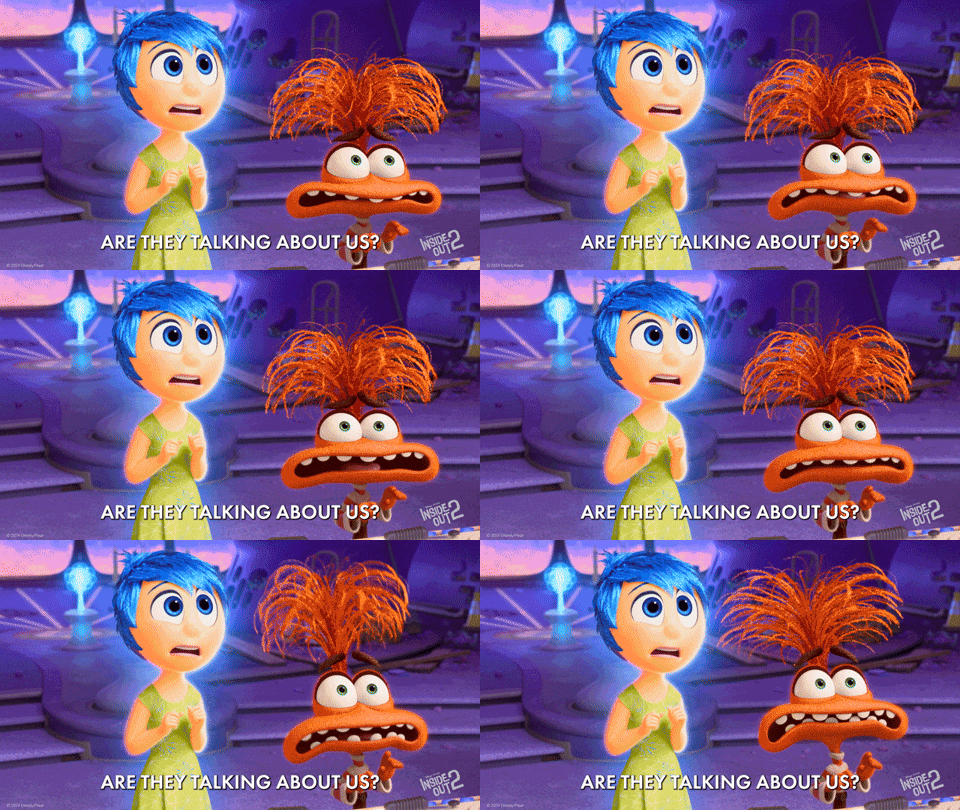
I admit it: I have a hypervigilant radar. Unpredictable environments make me feel unsafe, so I move through the world with a bit of social paranoia. I overthink, overextend, and neglect myself just to create a sense of peace that no one else even realizes is missing.
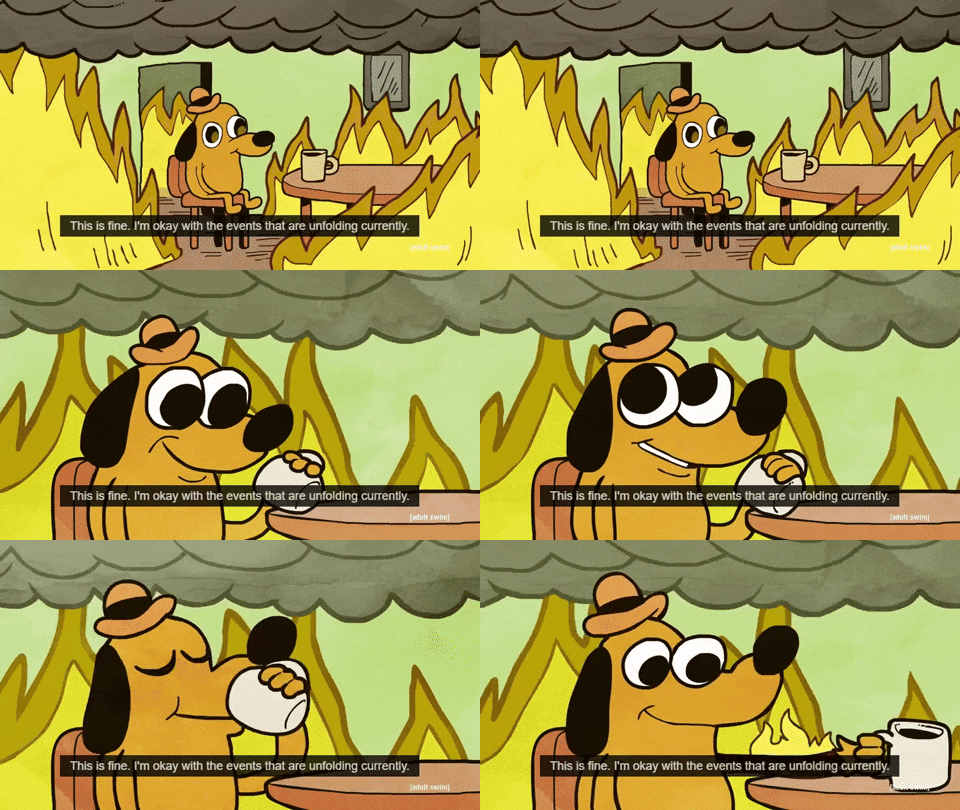
At first, it's invisible. I just look caring, attentive, and nurturing. But eventually, the bill comes due. Before I know it, I’m burnt out, depressed, and deeply uninspired. My intuitive channels will feel clouded, and I turn into a confused helicopter parent over my own life—feeling entirely powerless against invisible obstacles that I subconsciously created by spending weeks obsessing over old patterns with people in my life instead of channeling that energy into the projects I currently need to be building.
That right there? That is an energetic leak.
“My unhealthy fixation on problem-solving stole my sleep, made skipping meals a necessity and prevented me from ever asking for help. My physical and mental health deteriorated. Still, I hid the intense compulsions behind my efforts because my mind was an imperfect aspect of my life I couldn’t do anything about.”
- Beth Rush on her experience with Optimization OCD in “Spiraling Into a Burnout”
Whether people are conscious of it or not, energy is constantly being exchanged, and energy leaks can become quite distracting when left unchecked. These are the places and faces where you’re actively bleeding your time, attention, and energy—conversations (real or imaginary), online spaces, music, and media…
They can be big; they can be small. But add them up, and you can end up subconsciously blocking or delaying all of your hopes, dreams, wishes, and prayers. You can waste so much energy on everything and everyone that you become too depleted to show up for yourself. So it’s incredibly important to be aware of where you choose to make yourself available—even in thought.
Ironically, though, protecting my mental space is where I usually crash and burn. Maybe this is a very specific and deeply annoying 12th house experience, but having my Leo Sun and Mercury sitting there means I practically live, breathe, think, and speak from the porous house of the subconscious and unseen. Which makes it very hard not to lose myself in the noise of everything and everyone around me. As a Virgo rising, my identity is naturally tied to stepping in and trying to micromanage the psychic chaos I feel.
But when you throw in my Pisces 7th house + Jupiter, it really becomes a losing battle. Jupiter expands everything it touches, and in my house of one-on-one relationships, it helps Pisces (the natural ruler of all that 12th house energy) to completely dissolve my boundaries. I don’t just connect with the people that I meet—I absorb their energy, their confusion, and their illusions. I burn through my own energy romanticizing people and stabilizing their scales, all just to feel secure in myself.
When a shared or anticipated plan suddenly falls apart, my psychological defense mechanisms immediately kick into high gear to shield me from the discomfort of the unknown. It usually starts with assumptions, like the classic, “I already know exactly where this is going.” And when you’re an intuitive, empath, or navigating life with a neurodivergent brain like me, these energy leaks are rarely just about interpersonal drama. They dictate how we navigate everything we encounter in the world, fundamentally shaping our daily lives through the invisible patterns we constantly trace and absorb.
The thing is… intuition itself isn’t the issue, and sensitivity isn’t a glitch. But both start to feel like massive burdens to the person carrying them when our nervous systems are trained to stay on permanent high alert. We get caught in these agonizing bottlenecks where we crave genuine connection, but the moment we sense even a microscopic shift in someone’s energy, we completely abandon our own center—treating their unspoken, heavy moods like a crisis we were personally hired to solve.
Let’s just say it cleanly: it’s not my job to be a caretaker for someone I did not birth! It’s not my job to decode the silence of someone avoiding their own truth! Or to play the therapist or placeholder partner just to keep a connection from collapsing! It’s also not my place to force communication or closure on my desired timeline just because my nervous system is screaming for relief while someone else might genuinely never be ready to face themselves!
Saying it feels embarrassingly simple, but executing it when you can physically feel people’s mood shifting downstairs, or sensing the coldness across an app, is a whole different sport in practice.
Plugging the Drain
The leaks in my life lately have required physical, undeniable cuts. I like to go through my camera rolls and delete photos of people who no longer exist in my space. Not coming from a place of bitterness or some dramatic outburst, but I do have to acknowledge that the ghost has officially left the building. I don’t need the digital clutter tethering me to someone I’ll eventually find myself ruminating about. I even resumed clearing out a lot of the anxious, violent, and depressing music from my playlists because sometimes my nervous system cannot tell the difference between art and an actual trigger when I am trying to wind down or uplift myself.
Then there’s the emotional distance, which is the version that actually stings but is the most necessary. You can care for someone deeply and still need to build a real, unyielding gap between you mentally. It’s not a punishment or a game of silent treatment; it’s just a necessary energetic shield when you are the one who’s more sensitive to what’s going on underneath the surface of the physical reality.
Energy leaks and their plugs look different for everyone, and enforcing these boundaries isn’t always a clean, linear process. Even with your guard up, the ghosts of old dynamics can still slip through. But you eventually have to learn how to step back and pull yourself away, no matter how right, confused, or intuitive you think you are.o
It’s easy to claim that you trust the universe when everything is smooth, but sitting in the discomfort of an unresolved situation without trying to manipulate or control it is where the real integration happens. It means leaving room for a different outcome than the one I predicted. It means accepting that being hyper-vigilant about everyone else’s unspoken feelings was never actually in my job description. But being present in my body is.
Looking back at the absolute worst periods of my mental health, the exhaustion was never just about my own life; it was the massive energetic leakage I couldn’t see that I needed to plug. Releasing other people’s opinions, emotions, and responsibilities, even if it feels disjointed, unconventional, and uncomfortable, is the exact moment the spiritual work stops fighting the mental health work and they finally start working together.